
Call Us Now 416-301-8011
Toronto Construction Site Readiness Checklist: What Must Be Completed Before Demolition?
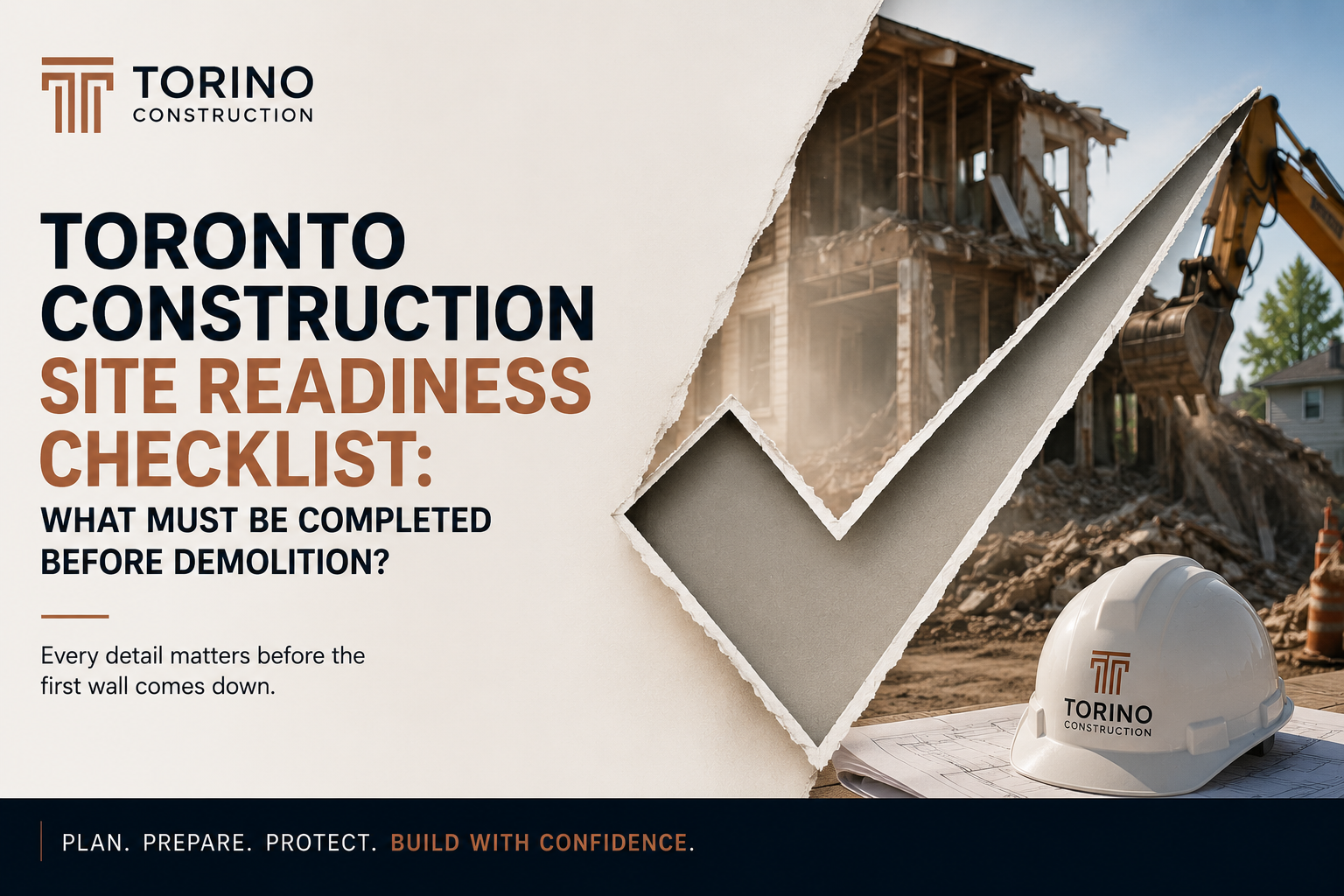
A Demolition Permit Doesn’t Mean the Excavator Can Arrive Tomorrow
Receiving a demolition or building permit is an important milestone—but it doesn’t necessarily mean your property is ready for demolition.
Before heavy equipment arrives, there are several critical site-readiness items that must be addressed.
Utilities need to be disconnected. Underground services need to be located. Required tree protection measures may need to be installed. Site fencing and notices need to be in place. Neighbours should be informed, and existing conditions around the property should be documented.
Missing one of these steps can turn what should be an exciting start to your project into an unnecessary delay.
At Torino Construction, we use a structured Pre-Construction Site Readiness process before demolition. Our rule is simple:
No machinery mobilizes until the required pre-construction checks have been completed and verified.
Here’s what we look for before demolition begins.
1. Utility Disconnections Must Be Confirmed
One of the most important pre-demolition tasks happens before an excavator ever enters the property: making sure existing utilities have been properly dealt with.
For a typical Toronto residential demolition project, this may involve coordinating with:
Enbridge Gas
Gas service needs to be properly disconnected rather than simply assuming that shutting off a valve makes the property safe for demolition.
Our pre-construction process requires documentation confirming the gas disconnection before demolition proceeds.
Toronto Hydro
Electrical service must also be properly disconnected, with related service equipment removed or otherwise safely addressed as required.
Toronto Water
The existing water meter and service also need to be dealt with before demolition. Confirmation and supporting documentation should be retained as part of the project record.
Ontario One Call
Underground utility locates are another essential part of site preparation.
Current locates help identify underground infrastructure before excavation begins. Because locates have validity periods, they should also be reviewed to make sure they remain current when work starts.
Torino Site Readiness Check:
- Gas disconnection confirmed and documented
- Hydro disconnection confirmed and documented
- Water meter/service requirements completed and documented
- Underground utility locates obtained and current
A permit authorizes the work. Utility verification helps make sure that work can begin safely.
2. Tree Protection Must Be Installed Before Site Activity
Trees can significantly affect how a Toronto construction site is prepared.
Where Tree Protection Zones (TPZs) apply, the approved protection measures should be established before construction activity begins.
This can include:
- Protective fencing
- Tree Protection signage
- Restrictions on material storage
- Restrictions on equipment access
- Protection from excavation or construction debris
The protected area should remain free from soil piles, construction materials, machinery, garbage, and other site activity.
Where work must occur near the edge of a protected area, additional arborist involvement or approved excavation methods may also be required.
Torino Site Readiness Check:
- Required TPZ fencing installed
- Tree Protection signage installed
- Arborist requirements reviewed
- Protected area clear of materials and equipment
Tree protection isn’t something that should be figured out after excavation begins. It is part of preparing the site before work starts.
3. Required Construction Notices and Signs Must Be Posted
A properly prepared construction site should clearly communicate what is happening on the property.
Depending on the project, site postings may include:
- Building Permit Card
- Applicable demolition or construction notice
- Health & Safety at Work poster
- WSIB In Case of Injury poster
- 24/7 emergency contact information
- Tree Protection signage, where applicable
Signs should be installed where they are visible and protected from weather and site damage.
The permit displayed on site should also correspond with the current project documentation.
Torino Site Readiness Check:
-
Building Permit Card displayed
-
Applicable public notice posted
-
Required safety information displayed
-
Emergency contact information visible
-
Tree Protection signage installed where applicable
Good signage isn’t simply administrative paperwork. It helps inspectors, workers, neighbours, and emergency responders understand who is responsible for the site and how the project is being managed.
4. The Construction Site Must Be Secured
Before demolition, the property needs to transition from a residential property into a controlled construction site.
That means access needs to be managed.
Torino’s pre-construction process includes checking that required safety fencing or hoarding is installed, stable, secured, and capable of restricting unauthorized access.
The entrance should also be controlled so that children, neighbours, pedestrians, or other members of the public cannot casually enter the construction area.
Torino Site Readiness Check:
-
Site perimeter secured
-
Required fencing/hoarding installed
-
Gates secured
-
Public access restricted
-
Construction entrance established
This step protects more than the construction crew. It protects the homeowner, neighbours, and the public.
5. Existing Conditions Should Be Documented
This is one of the most valuable pre-construction steps—and one homeowners rarely think about.
Before demolition begins, professional builders should document existing conditions around the site.
At Torino Construction, this includes photographic and video records of areas such as:
Neighbouring Properties
- Exterior walls
- Windows
- Fences
- Driveways
- Areas immediately adjacent to construction
Municipal Property
- Sidewalks
- Curbs
- Utility poles
- Fire hydrants
- Other visible public infrastructure near the site
Why does this matter?
Imagine that several months into construction, someone claims that a fence, driveway, sidewalk, or neighbouring wall was damaged by the project.
Without a pre-construction record, determining what existed before construction can become difficult.
A detailed photographic record provides a baseline.
Torino Site Readiness Check:
-
Site photographs completed
-
Surrounding properties documented
-
Municipal assets documented
-
Video record completed
-
Files securely stored with the project documentation
Good documentation doesn’t create conflict.
It helps prevent it.
6. Neighbours Should Know What’s About to Happen
Demolition affects more than one property.
There will be equipment arriving, trucks moving, noise, dust, deliveries, and increased activity around the site.
Neighbours shouldn’t discover that demolition is starting when they wake up to an excavator next door.
As part of Torino’s pre-construction process, neighbouring properties are notified before work begins and provided with basic project information and contact details.
A neighbour notice can include:
- Project address
- Demolition start date
- Builder information
- Project Manager contact information
- 24/7 emergency contact information
Torino Site Readiness Check:
-
Adjacent neighbours notified
-
Neighbours across the street notified where appropriate
-
Project contact information provided
-
Notification record retained
Early communication can prevent misunderstandings from becoming complaints.
7. Dust-Control Measures Should Be Ready Before Demolition
Demolition can generate significant dust very quickly.
Waiting until dust is already drifting toward neighbouring properties is too late to start thinking about suppression.
The site should have appropriate dust-control measures ready before demolition begins, including access to water and spraying equipment where required.
Torino Site Readiness Check:
-
Water source available
-
Dust-suppression equipment ready
-
Demolition team understands dust-control procedures
-
Neighbouring properties considered in the demolition plan
Preparation helps keep the site cleaner and reduces unnecessary impact on the surrounding neighbourhood.
8. Contractors Need Clear Site Rules
Site readiness isn’t only about physical preparation.
Everyone entering the site should understand how the project will operate.
Torino’s subcontractor site standards address areas such as:
- Permitted working hours
- Parking
- Keeping sidewalks and driveways clear
- Fire hydrant access
- Site cleanliness
- Smoking and waste
- Communication with neighbours
- Communication with inspectors and municipal officials
Formal communication with neighbours, inspectors, or City representatives should be handled by the Project Manager or designated site representative.
That creates one clear line of responsibility throughout the project.
The Final 48-Hour Pre-Demolition Check
Before machinery mobilizes, our team performs a final review.
The core readiness items include:
-
Utility disconnection documentation is complete
-
Required Tree Protection Zone fencing and signage are in place
-
Applicable public notice requirements have been completed
-
Safety fencing/hoarding is installed and secured
-
Neighbour communication has been completed
-
Pre-construction photo and video documentation has been completed and archived
If something isn’t ready, the answer isn’t to hope it won’t become a problem.
The answer is to resolve it before demolition starts.
Site Readiness Is What Separates a Permit from a Prepared Project
A building permit is important.
But a permit alone doesn’t disconnect a gas line.
It doesn’t protect a tree.
It doesn’t document the neighbour’s driveway.
It doesn’t secure the construction site.
And it doesn’t tell the family next door what’s about to happen.
That’s why professional pre-construction management matters.
The goal isn’t simply to get an excavator onto the property as quickly as possible.
The goal is to make sure that when demolition begins, the project is genuinely ready to move forward.
Planning a Demolition or Custom Home in Toronto?
At Torino Construction, pre-construction planning is part of how we protect the homeowner’s investment before construction even begins.
From utility coordination and tree protection to site documentation, neighbour communication, signage, and final readiness checks, our team works through the details before heavy equipment arrives.
Because a successful custom home doesn’t begin with demolition.
It begins with a properly prepared site.
Contact Torino Construction to discuss your custom home, demolition, home addition, or residential infill project in Toronto and the GTA.
Call For A Consultation

© Copyright 2026 Torino Construction. All rights reserved.